Reading a script shows — how to talk on camera with a bullet script and a pre-shoot routine
inflee team
9/1/2026
“As soon as the camera turns on, my mind goes blank.”
“If I write a script, it’s obvious I’m reading it. If I don’t, I ramble.”
Speaking on camera is the biggest wall for new creators. But there’s a misconception here: creators who speak well weren’t born that way. They know how to prepare so that they sound natural.
The key is this: don’t memorize a full script, and don’t improvise with no plan. The answer is in between — a bullet script and a rehearsal routine. This article lays out the whole method.
Why reading a full script sounds awkward
When you write out every word and read it, three problems appear.
- Your eyes follow the text. You’re not looking at the camera, so it’s obvious you’re reading.
- The rhythm dies. Written language lacks the natural intonation and pauses of real conversation.
- One slip and everything falls apart. The moment you leave the memorized sentence, your mind goes blank.
And with no preparation at all? You get rambling and a parade of “um… so… like…” That’s why the tool we’ll use is the bullet script.
The bullet script: write signposts, not sentences
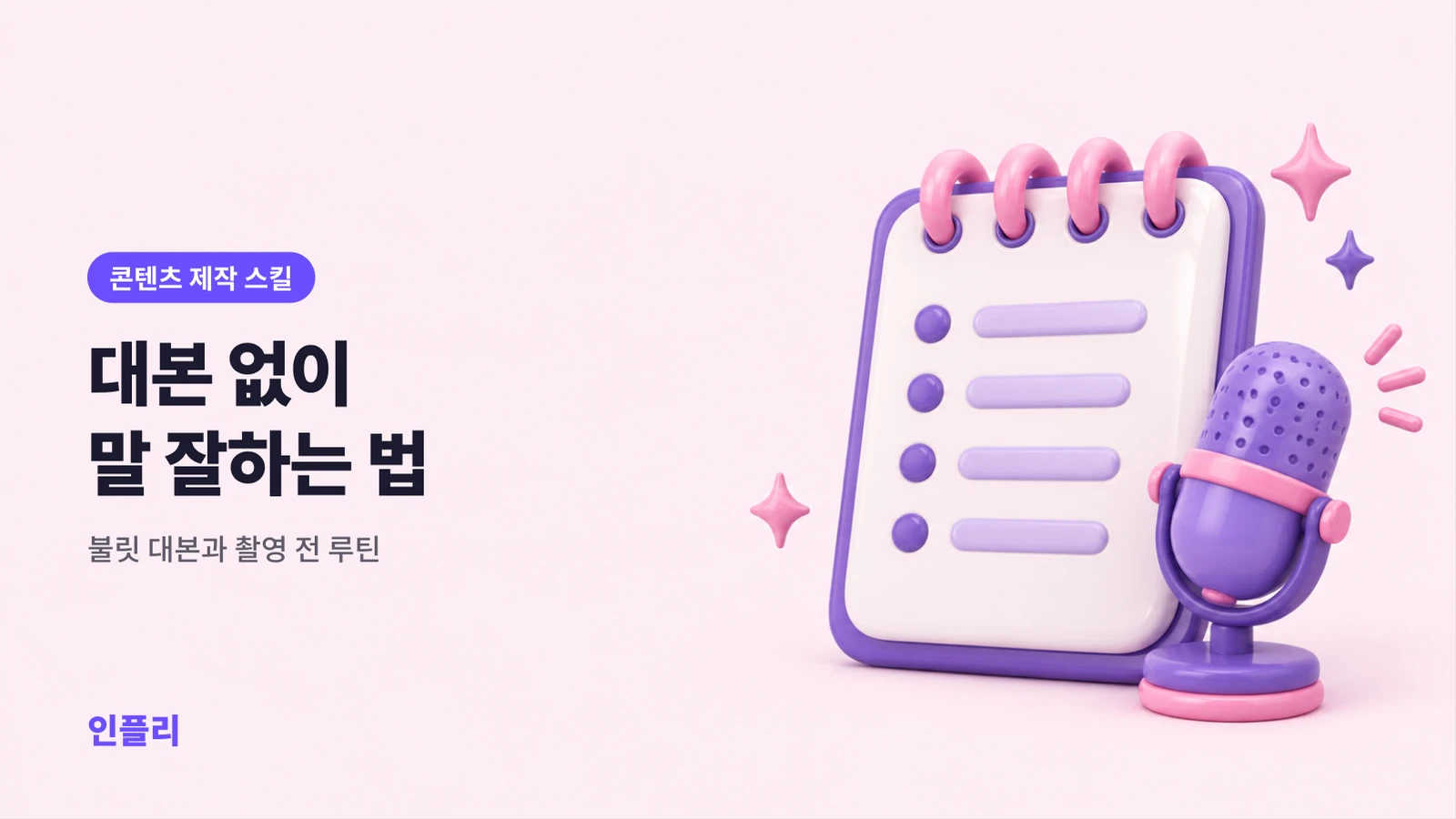
A bullet script doesn’t write out everything you’ll say. It lists only the key points as keywords. The words come out naturally in the moment; the bullets just keep you on track and in order.
Full script vs bullet script
Full script (stiff): “Hi everyone. Today I’m going to share three lighting tips I use when filming on my phone. The first is using window light. If you sit facing the window…”
Bullet script (natural):
- Hook: “One light, twice the video quality”
- Tip 1: window light — sit facing the window (watch out for backlight)
- Tip 2: ring light — catchlights in the eyes
- Tip 3: light from behind — adds depth
- Close: try just one today → tease the next video
From the bullets alone, you can explain each point in your own words — and that sounds far more alive.
What every bullet script needs
- The hook, written in full. This is the one line to script word for word. The opening decides completion, so prepare your first sentence exactly.
- Key points in order. The points you can’t skip, in sequence.
- Transitions. Signals like “Next up” or “Here’s the important part.”
- Close and call to action. How you’ll end and what you’ll ask for — follow, save or watch the next video.
The basic structure: hook, body, close
Whatever you talk about, this skeleton keeps you steady.
1. Hook (0–3 seconds)
- Skip the greeting and introduction. Open with something interesting.
- Example: “If you don’t know this, buying more lights won’t help.”
- Questions work well too: “Do your videos keep coming out dark?”
2. Body (two to four points)
- Keep it to about three points. Too many and nothing sticks.
- Make each point short: claim, then reason or example.
- Use transitions so viewers know which point they’re on.
3. Close (summary and call to action)
- One-sentence summary: “So: window light, ring light and backlight.”
- A clear action: “Try just one today,” or “Save this for your next shoot.”
- Tease the next video to keep viewers coming back. If you’re building a series, see how to judge a series by its return rate.
How to cut stumbles and filler words
“Um…,” “uh…,” “how do I put this” — here are practical ways to cut these fillers.
1. Don’t fear silence
Fillers come from fear of silence. You plug the gap with “um” until the next thought arrives. But a short pause can simply be cut in editing — silence is much easier to trim than fillers. When you get stuck, pause for a second instead of saying “um.”
2. Keep sentences short
Long sentences tangle halfway through. Break them up. Instead of “So I did this and then that and after that it turned out…,” say “I did this. Then it changed.”
3. Film in chunks
Don’t try to deliver three perfect minutes in one take. Film one point at a time and join them in editing. The pressure drops, and if you slip, you only reshoot that chunk.
4. Record yourself and listen
You rarely notice your own verbal habits. Record once and listen back, and you’ll hear things like “I say ‘kind of’ a lot” or “I trail off at the end.” Once you know, you can fix it.
A pre-shoot rehearsal routine: five minutes saves ten takes
Turn on the camera without preparing and you’ll do ten takes. Follow this routine and you’ll be done in one or two.
Five minutes before you film
- Read the bullet script out loud once. Not just with your eyes — with your mouth. Saying it reveals where you trip.
- Repeat the hook three times. Until the first line feels natural. A smooth start makes the rest flow.
- Warm up your mouth and face. Open wide, exaggerate a few vowel sounds, stretch your cheeks. Your speech gets clearer.
- Film a ten-second test. Check sound, brightness and framing, and shake off camera nerves.
- Drink some water. A dry mouth blurs pronunciation and adds mouth noises.
While you film
- Put your notes right next to or just below the lens, so your eyes never stray far.
- Treat the lens like a friend’s eyes. You’re having a conversation, not giving a lecture.
- If you slip, don’t stop — repeat that sentence and keep going. Cut the mistake in editing.
- Raise your energy about 20% above normal. The camera flattens energy; what feels just right in person looks dull on screen.
Habits for a natural tone
- Use everyday words: “use” instead of “utilize,” “buy” instead of “purchase.”
- Speak directly to your viewer as “you”: “Try this and you’ll see.”
- Use your hands. Gestures bring life to your voice.
Pre-shoot speaking checklist
- I prepared a bullet script, not a full script.
- I wrote my opening hook word for word.
- I narrowed it down to about three key points.
- I decided on my close and call to action.
- I rehearsed out loud at least once.
- I practiced the hook three times.
- I warmed up my mouth and face.
- My notes are next to the lens.
- I’m filming in chunks to spread the pressure.
- I have water ready.
Not perfect speech — comfortable speech
Viewers don’t want broadcast-perfect delivery. They like the feeling of a friend explaining something casually. A few stumbles or an imperfect tone are fine; what matters is sincerity and clarity.
Use a bullet script to hold your points, rehearse to nail your first line, and film in chunks to spread the pressure. It will feel awkward at first, but after about ten videos there comes a moment when the camera feels comfortable. Speaking on camera isn’t talent — it’s repetition. If you’re just starting out, pair this with a roadmap for your first 100 posts.
Creators who speak well are especially strong in brand collaborations — introducing a product naturally is exactly what brands look for. When you’re ready to show that work off, gather it on one page with inflee’s free creator tools.
inflee team
inflee marketing
Everything about influencer marketing, from inflee.