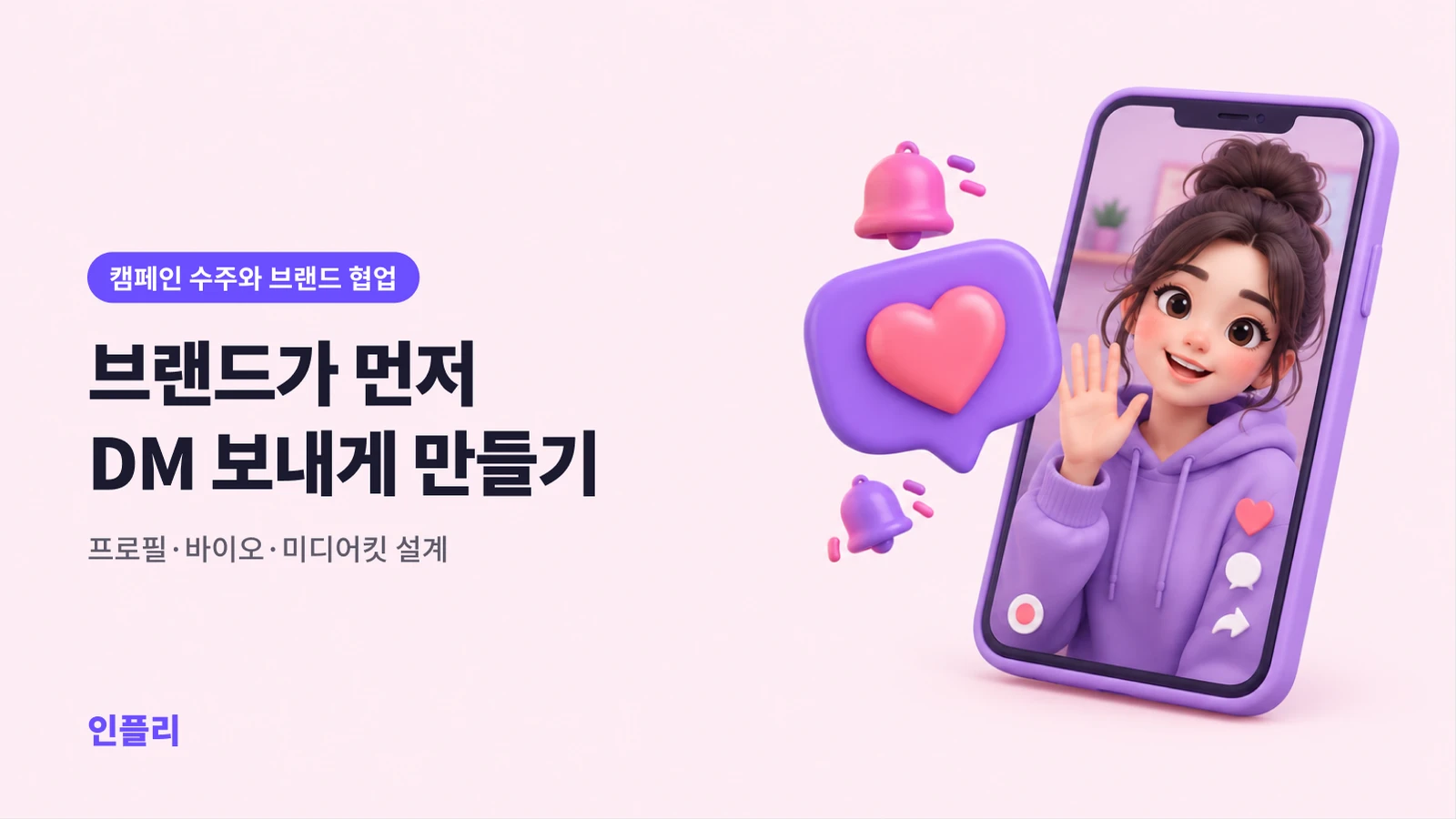
How to get brands to DM you first: a complete guide to your profile, bio and media kit
inflee team
7/18/2026
“Lots of brands visit my Instagram, but very few turn into actual offers. Why don’t they reach out?”
Creators with 30,000 to 100,000 followers share this frustration. There’s traffic but no conversion. A brand manager skims your profile for 30 seconds and leaves — and those 30 seconds decide most of whether an offer happens.
The problem is that many creators assume great content is enough and brands will just come. In 2026 that’s not how it works. After a year of rapid expansion in creator marketing, brands are now focused on efficiency: how to manage and sustain programs at scale. They judge fit in about 30 seconds, and if something’s missing, they move to the next account.
So your profile needs to work as a sales window, not just a content archive. This guide walks through profile, bio, Highlights, link page and media kit — everything that helps a brand decide within 30 seconds that it wants to work with you. It’s based on public industry guides and common portfolio practice; results vary by category, audience and quality.
A brand manager’s 30 seconds
Here’s the order in which a brand marketer checks your profile:
- 0–3 seconds — first screen (bio and the latest three to six grid posts): is the category clear, and does the tone match the brand? If not, they leave.
- 3–10 seconds — followers and recent posts: do the followers look real, is the account active, does engagement look healthy?
- 10–20 seconds — Highlights: are there past collaborations, a media kit or contact details, a sense of who you are?
- 20–30 seconds — one or two posts in detail: is quality consistent, what’s the comment atmosphere, do you reply?
- Decision: send a DM, or move on.
In those 30 seconds a brand wants six things: a category match, follower credibility, recent activity (steady posting in the last two weeks), collaboration history, an easy way to contact you, and consistent content quality. If three or more are unclear, most brands leave. Instant red flags include a mixed category (beauty, fashion and food all at once), no posts in two weeks, no collaboration Highlight, no email in the bio, spam-like comments and unusually low engagement for your follower count.
Profile photo and name: the one-second zone
For the photo: if you’re the face of your channel (beauty, fashion, lifestyle), use a well-lit, centered shot with a simple or blurred background, your brand colors and at least 1080×1080 resolution. If you use a logo, keep it a simple wordmark or symbol that survives the circular crop. Refresh it every few months — an old photo signals a stagnant account.
Your handle should match your real or creator name. The display name is where search visibility lives. Use the formula [your name] | [category keyword]: “Jiyoung | Ingredient-focused skincare reviews,” “Sam | Minimal wardrobe for your 30s,” “Alex | Studio apartment recipes.” Avoid emoji-only names, decorative Unicode fonts that search can’t read, and generic names like “Jiyoung’s daily life.” A keyword in your display name helps you rank in Instagram search and appear when a brand searches for “skincare reviewer.”
Your bio: everything in 150 characters
Instagram bios are limited to 150 characters, so pack in eight elements:
- Category: what you cover — “Sensitive-skin ingredient reviews.”
- Credibility: why people should trust you — “Former cosmetics researcher,” “Editor for 4 years.”
- Social proof: “100K total saves,” “1.5M monthly reach.”
- Main format: “Reels Mon/Wed, ingredient breakdowns Fri.”
- Value: what followers get — “Honest new-product reviews every week.”
- Contact: a business email — essential.
- Link: one link that leads to your media kit, shop and latest work.
- Direction: a hint at the collaborations you welcome.
Example: “Jiyoung | Sensitive-skin ingredient reviews · Ex-cosmetics researcher, 4 yrs · 100K saves, 1.8M monthly reach · Reels Mon/Wed · Collab: biz@jiyoung.com · Media kit below.” Update your bio at least every three months, refresh numbers quarterly and tag campaign brands during a partnership.
Highlights: a mini portfolio for brands
Highlights are where a brand sees your skill, story and contact details in a few seconds. Treat them carelessly and you lose opportunities. Seven essentials, in order:
- About: who you are, how you started, what you cover and three values you stand for.
- Work: past brand collaborations, two or three slides each (brief, content, results), newest first.
- Results: average reach, engagement and save rate, standout campaign results and a growth chart.
- Contact: email, media kit link and expected response time (“replies within 24 hours”).
- Best: your five to ten most saved and shared videos, labeled by topic.
- Reviews: products you’ve reviewed by category and your review principles.
- FAQ: common collaboration questions, rough rate ranges and the content types you offer.
Keep covers consistent (same colors and type), use simple icons or short text, limit yourself to three to five brand colors and keep titles short. Avoid Highlights that are only “daily life” or “random,” mismatched covers, travel and selfie dumps, and missing collaboration or contact information. Good Highlights let a brand understand you well enough to decide even before seeing your media kit.
Your link-in-bio page: seven essential links
One link in your bio should lead to every destination that matters. A free link-in-bio page lets you set this up in minutes. Prioritize:
- Collaboration email — with a pre-filled subject line such as “Instagram collaboration inquiry.”
- Media kit — a one- to three-page PDF or public document link.
- Recent signature campaigns — two or three Reels or videos.
- Your shop or merchandise — if you sell your own products.
- Newsletter or membership — if you have one.
- Your other platforms — in order of importance.
- Creator platform profiles — any discovery platforms you’re listed on.
Pair one emoji with clear text, use action phrases like “See this week’s picks,” and pin time-limited links to the top during campaigns. Avoid listing fifteen or more links, broken links and links outside your main topic. Check click data monthly and move the most-clicked link to the top.
The media kit: your decisive one-pager (or three)
Attach it to pitch emails, and when a brand asks for your media kit, send a link and you’re done.
- Page 1 — introduction: name, logo or photo, a two- or three-line intro, three keywords; a dashboard of key numbers (followers per platform, average monthly reach, save and share rates, main age group and gender); three to five signature posts; and three lines on what a brand can expect from working with you.
- Page 2 — audience insights: age and gender, top five locations, top five interests, engagement trend, performance by format (Reels, feed, Stories) and six-month growth.
- Page 3 — case studies and rates: three to five past brands, each summarized as problem, action and result with concrete numbers; rough rate ranges by content type with final quotes in a meeting; usage rights and exclusivity negotiated separately; and contact details with a link to book a call.
Design principles: match your channel’s colors and fonts, turn numbers into charts, update quarterly with a version in the file name, prefer PDF (or a live document page), keep it under 5MB, and prepare versions in the languages your target brands use. Making it yourself takes 10–20 hours with free design tools — one investment you’ll use for a year or more.
The audience numbers brands want
From your professional account insights, prepare ten numbers: followers, monthly reach, follower share of reach, follower age and gender, top five locations, average engagement rate, average save rate, average share rate, Story reply rate and monthly follower growth. Your Instagram insights cover most of them.
Engagement rate = (likes + comments + saves + shares) ÷ reach × 100. For example, 5,000 + 200 + 800 + 150 = 6,150 interactions on 45,000 reach is 13.7%. Save rate deserves special attention: it signals content worth coming back to, which predicts conversion better than reach alone.
Present data specifically. Not “50K followers, high engagement,” but “Average monthly reach 1.57M (+45% year over year) · 78% women, 62% aged 25–34 · top cities listed · save rate 1.6%, about twice the category average · top interests: beauty, wellness, lifestyle.” Rewrite these numbers every quarter.
Profile tips by category
- Beauty and skincare: “ingredient reviews” in the bio, Highlights like “ingredient glossary” and “repurchase list,” a consistent color palette and a clear audience gender split.
- Fashion: height and size in the bio for fit credibility, seasonal lookbooks and outfit archives, a rhythm of full shots and detail shots.
- Food and cooking: your diet style in the bio, recipe collections, and household type of your audience (single, couple, family).
- Home and interiors: home size and household in the bio, house tours and before-and-after Highlights.
- Education and knowledge: specific credentials, course lists and tool recommendations, with courses or newsletter at the top of your link page.
- Lifestyle: a specific niche (“minimal living in your 30s”), daily routines and what makes you different.
A monthly self-check
Look at your profile as a brand would: fresh, high-resolution photo; keyword in display name; all eight bio elements; three or more posts in the last two weeks; consistent grid; the seven Highlights with matching covers; media kit reachable from your link page and updated in the last three months; active collaboration email; comment replies within 24 hours. Nine or more: you’re set. Six to eight: fix the gaps this week. Five or fewer: plan a full redesign over the next month.
Example: a two-week profile overhaul
A hypothetical fashion creator with 32,000 followers, two years in, gets three to five mostly low-budget offers a month. Her bio reads “Fashion, daily life, DM for business”; she has twelve unrelated travel Highlights, no link page and no media kit. In week one she defines her positioning — “minimal wardrobe expert for women in their 30s,” with honest fit reviews as her strength — and books a new profile photo. In week two she rewrites her bio (height and size, monthly reach, save rate, posting schedule, email), cuts Highlights from twelve to seven with matching beige covers, finishes a three-page media kit in two languages and sets up a link page with the media kit and email at the top. Within a month she receives 14 offers instead of 5, average proposed fees rise by about half, and the share of poorly matched offers falls from 70% to 35%.
Frequently asked questions
I have 10,000 followers. Do I need a media kit? Yes. A media kit is proof of expertise, not size — and a micro-creator can be a better fit than a bigger account.
Should I put rates in my bio? No. It reduces you to a price. Share ranges in your media kit and exact quotes in a meeting.
I’m interested in several categories. Pick one main category and add one or two secondary ones in parentheses. Brands look for the go-to person in a field.
Won’t this look too commercial? Commercial and professional are different. A clean profile with a clear fit reads as professional — and audiences respect it.
I don’t want my numbers public. Add a “request media kit” link and send the PDF by email when brands ask.
Do I need a professional account? Yes. Switching to a creator or business account unlocks insights, takes five minutes and is free.
My followers dropped after I changed my profile. A sharp identity change can cost a few followers in the first weeks as poor-fit followers leave. Within a month or two you typically recover with better-matched followers and stronger brand appeal.
Once offers start arriving, read how to turn a first brand deal into an ambassadorship.
Summary
To get brands to DM you first, redesign your profile as a sales window rather than a content archive: a clear photo and keyword-rich name, an eight-element bio, seven purposeful Highlights, a link page with your media kit and email at the top, and a three-page media kit backed by real audience numbers. Check it every month, and the right offers start coming to you.
inflee team
inflee marketing
Everything about influencer marketing, from inflee.