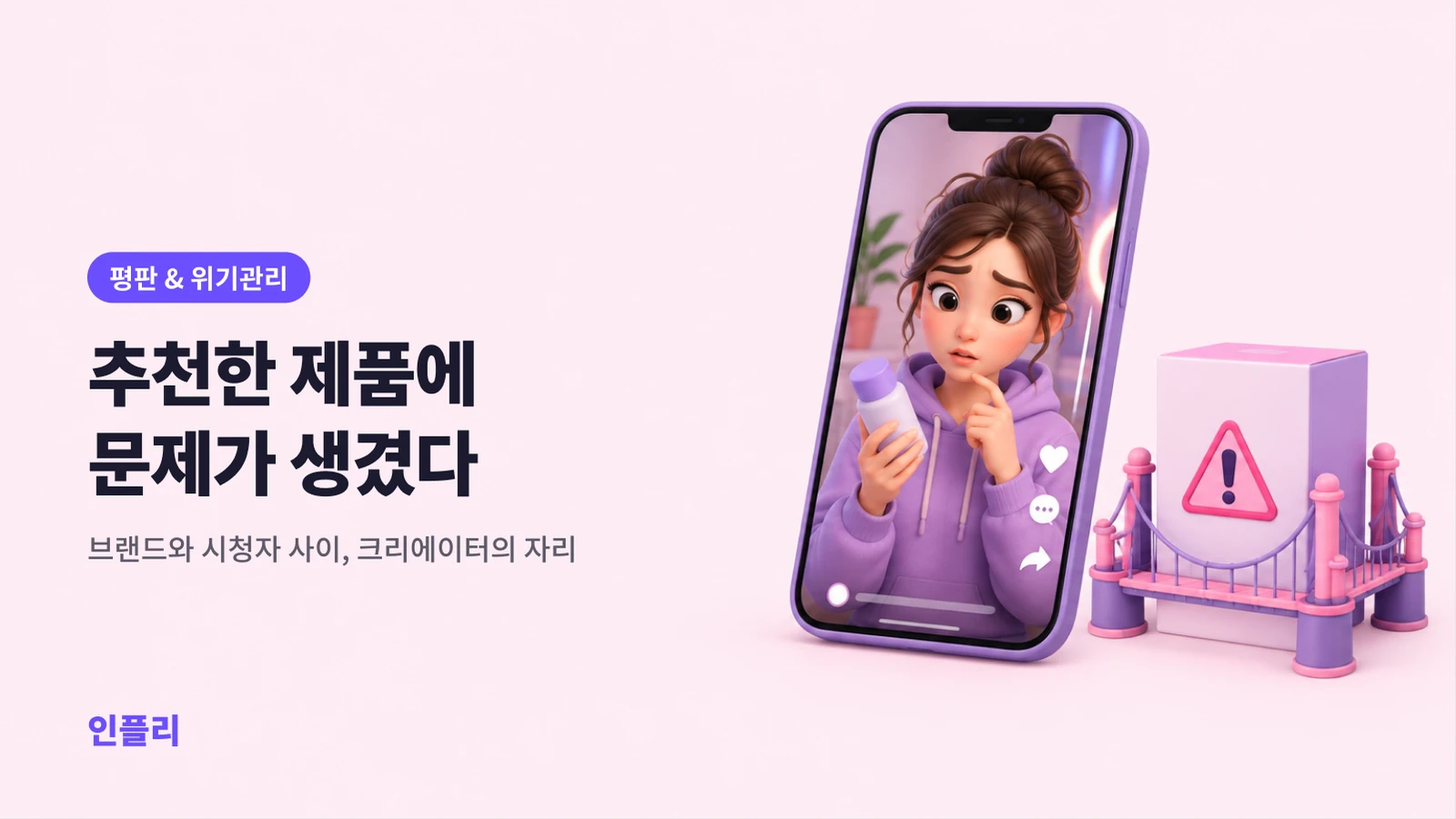
A product I recommended is in trouble — where creators stand between the brand and their audience
inflee team
10/2/2026
This is not about controversies caused by your own mistakes — weak disclosure or something you said are separate topics. This is a different situation: you recommended a product honestly, and then the product ran into trouble.
Maybe its benefits turn out to be exaggerated, there's a defect or a recall, or the brand gets caught up in a separate scandal. When a promoted product is recalled or questioned, viewers come to you before they go to the brand. They bought it because they trusted your face.
First, know exactly where your responsibility ends
When frustration and guilt mix, judgement gets blurry. Start by separating what is yours and what isn't.
| Item | Creator | Brand |
|---|---|---|
| Product quality and safety | No | Yes |
| Accuracy of ingredients and specs | No | Yes |
| Licences and legal labelling | No | Yes |
| Shipping, refunds, after-sales service | No | Yes |
| Disclosing the sponsorship | Yes | Shared |
| The scope of what you said | Yes | No |
| Your attitude once you know about the problem | Yes | Yes |
Only three rows are yours. The rest belong to the brand. Getting this clear stops you from over-apologising — and from over-defending.
In practice, "the scope of what you said" matters most. Reading the brand's material is different from making definitive claims based on your own experience.
| Type of statement | Example | If a problem appears |
|---|---|---|
| Passing on facts | "According to the maker, it contains X" | Safe — the source is clear |
| Personal experience | "After two weeks, this is how it felt for me" | Safe — clearly subjective |
| Definitive benefits | "Use this and you'll definitely see results" | Risky |
| Absolute comparisons | "The best one on the market" | You'll be asked for proof |
When something goes wrong, what protects you isn't the contract — it's how you spoke in the video.
Weigh the issue before you respond
Responding the same way to every problem means overreacting to some and underreacting to others. Weigh it on three axes.
| Axis | Question | Weight |
|---|---|---|
| Harm | Is there a real health or safety risk? | Highest |
| Certainty | Is it officially confirmed, or still an allegation? | High |
| Your involvement | Did you make definitive claims, or pass on information? | Medium |
Combined, they give four response levels.
| Level | Condition | Response |
|---|---|---|
| 1 | No harm + allegation only | No public response. If asked, just say you're looking into it |
| 2 | No harm + confirmed | Pinned comment with the facts + where to get help |
| 3 | Possible harm + allegation | Pinned comment explaining the situation + ask the brand to confirm immediately. Adding "I'd suggest holding off on buying until this is confirmed" is the safe move |
| 4 | Harm + confirmed | Make the content private + post a notice + point to the brand's support. Only here is a separate post justified |
Treating level 1 like level 4 is the most common mistake. Posting an apology over an unfounded allegation creates an issue that didn't exist and damages your relationship with the brand. Treating level 4 like level 1 destroys trust beyond repair.
Don't be afraid of the "hold off on buying" line at level 3. The brand may dislike it, but staying silent when viewers' health is at stake costs far more. And if it turns out fine, you're remembered as careful, not as harmful.
Your default when you're unsure
- Viewer safety — if it's involved, it outranks everything else
- Facts — don't present unconfirmed things as confirmed
- The brand relationship — important, but after the first two
Swap the order and it's easier in the short term, but you lose much more in the long run. Brands come and go; your audience stays.
Your first 48 hours, step by step
0–2 hours: only check
Say nothing yet. The most common mistakes here are a hasty apology and a hasty defence — both are impossible to take back once the facts come out.
- What exactly is the problem? A defect, a claim, labelling, a brand scandal?
- Is there primary information — an official announcement, a news report, a regulator's notice?
- What exactly did you say about the product? Rewatch the video
- Does your agreement cover this?
The third point is key. Don't rely on memory — rewatch the video. You may have been more careful than you remember, or more definitive.
2–6 hours: contact the brand
The brand comes before the audience. Ask three things:
- What facts have they confirmed so far?
- What is their official position, and when will they announce it?
- How should the sponsored content be handled — keep, make private, or edit?
If the brand doesn't answer or avoids the question, that is your answer. They don't intend to respond together, so you need to act independently.
6–24 hours: decide what to do with the content
| Situation | Content | Why |
|---|---|---|
| Facts still being checked | Keep it + pinned comment | Deleting early looks like a cover-up |
| Safety issue or recall confirmed | Make it private + post a notice | Keeping it visible spreads the harm |
| Regulator action over false claims | Flag the specific claims + correct them | Correcting builds more trust than deleting |
| A separate brand scandal | Keep it + comment if needed | The product itself isn't the problem |
"Just delete it" is the most common — and worst — choice. Deletions get screenshotted, and "they deleted it" becomes a new issue. Unless it's a safety problem, keep the content and add an explanation.
24–48 hours: tell your audience
Keep it short, using the same structure: fact → your position → next step.
About the video on [product] I posted on [date]: [the specific issue] has been confirmed.
I introduced it based on the brand's information and my own use, and I wasn't aware of this problem at the time.
I've [what you did with the video], and if you bought it, please contact [brand's customer support].
Put something viewers can actually do in the last sentence. An apology without a path to a solution keeps the complaints coming to you. Pointing to refund and exchange channels moves most questions to the brand.
What not to do
- Explain on the brand's behalf — the moment you become their spokesperson, their responsibility becomes yours
- Stress that "I'm a victim too" — even if true, it sounds like dodging responsibility
- Lead the attack on the brand — it may breach your agreement and looks emotional
- Keep bringing it up — address it once and move on
What happens to your fee?
| Situation | Typical outcome |
|---|---|
| Content posted as agreed | The brand still owes payment |
| Made private at the brand's request | Payment stands (the brand's decision) |
| Removed before the minimum posting period | Possible dispute — check your agreement |
| Removed on your own decision | The brand may ask for a refund |
Check the minimum posting period clause. Many agreements require the post to stay up for a set time, often several months. Taking it down early on your own may count as a breach. Confirmed safety issues are different: notify the brand first, then make it private — most brands accept that. Just don't remove it without notice.
Next time — protect yourself at the agreement stage
- Ask whether the product has the licences and test reports it needs (just confirming they exist is enough)
- Use only wording provided by the brand for claims about benefits, and say where it came from
- Check whether the agreement says who is responsible if the product is defective
- State how the fee is handled if content comes down because of the brand
- Add a safety exception to the minimum posting period
- Actually use the product before filming
The last one is your strongest protection. Odd products usually show themselves when you use them, and you can speak from experience — which you can always explain later as "my experience at that time". Before agreeing, it also helps to negotiate the terms properly rather than accepting the first draft.
Products you're better off declining
| Signal | Why it's risky |
|---|---|
| They want you to state benefits definitively | They pass the false-claims risk to you |
| They want you to read a script word for word | The responsibility for what's said stays with you |
| They dodge requests for licences or test reports | The documents may not exist |
| They ask you to remove or shrink the ad label | A rule breach, and more blame if things go wrong |
| The fee is far above market | It may be paying you for the risk |
| They suggest going ahead without any agreement | You'd have nothing to rely on |
Be especially careful with the last one. Without an agreement, your fee, the limits of your responsibility and your posting obligations all become "he said, she said".
Frequently asked questions
"Viewers are asking me for refunds." Refunds come from the seller, not the creator. But "I'm not the seller, I can't refund you" sounds cold. Share the brand's support details, and if the brand isn't responding, push them firmly. The real help you can give is connecting people to the right channel.
"The brand isn't answering." Then act independently. Tell your audience only what's confirmed, handle the content as the situation requires, and keep records of your attempts to reach them — they'll matter if the fee or responsibility is disputed later.
"The brand wants my video to stay up, even though it's a safety issue." When a safety problem is confirmed, protecting viewers comes before the brand's request. If a minimum posting clause applies, notify the brand in writing, then make it private: "Following official confirmation of a safety issue, I'm making this video private from [date]." If they keep insisting, that's a reason not to work with them again.
"The problem surfaced long after I posted. Is it still on me?" Legal responsibility and how viewers feel are different. You generally can't be blamed for what nobody could know at the time, but viewers still feel let down. Share "I couldn't have known then" as an explanation, not a defence, and do what you can now — inform and correct. Staying silent because time has passed only makes it worse.
A sponsorship introduces a brand's product, but what viewers trust isn't the product — it's you. That's why problems reach you first. Two habits shrink that imbalance: keep your claims within your own experience, and work with brands that will stand with you when something goes wrong. Handling the comments that follow is easier with filters that hide abuse — see free creator tools — and for accusations about disclosure, read how to reply to a hidden-ad accusation in three sentences. Next time you review an offer, check it against the six red flags above.
inflee team
inflee marketing
Everything about influencer marketing, from inflee.