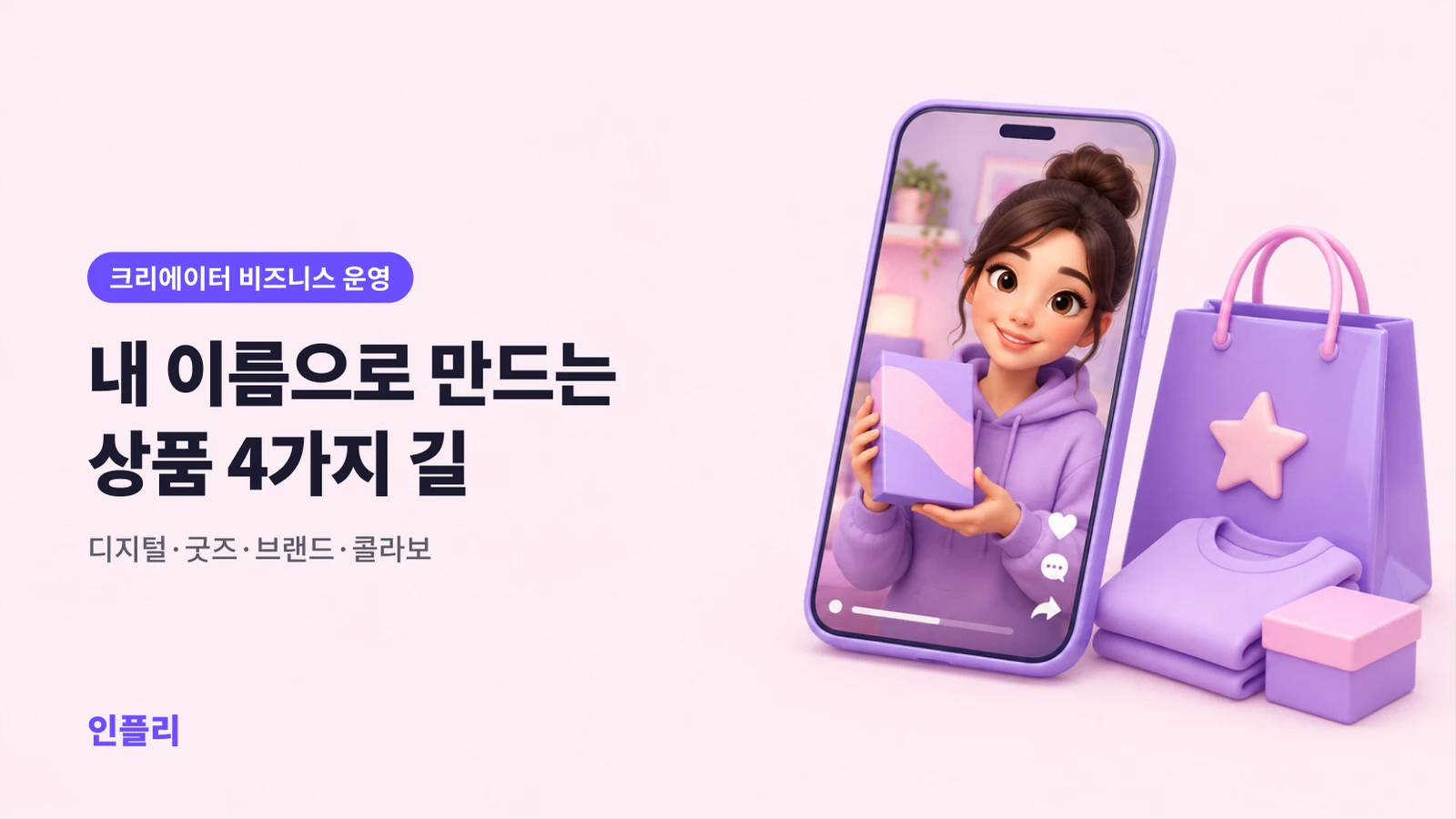
Sponsorships only go so far — 4 ways creators launch products under their own name (digital, merch, collabs, own brand)
inflee team
7/24/2026
"I've done nothing but sponsorships for three years. My income went up, but I don't own anything. If my followers dropped to zero tomorrow, nothing would be left."
This is one of the most common realizations among creators in their third or fourth year. If you keep repeating brand deals without ever building a product with your name on it, you are not building assets of your own — no matter how many followers you have. Your channel is effectively a media outlet for a brand you have not made yet.
The wider market points the same way. Creator merch and collaboration products have become one of the biggest parts of the creator economy, and brands increasingly invest in individual creators and their communities rather than only in platforms. At the same time, the tools to sell your own products — online storefronts, print-on-demand and digital download platforms — have never been easier to use.
This post lays out four paths to launching creator products under your own name, in the order most creators should try them: digital products (easiest to start), merch (turning fans into customers), co-branded collaborations (the middle step) and your own brand (the final stage). For each, you will see when to start, what it takes, the risks and how to launch.
This is a general framework. Actual revenue varies enormously by category, audience size and market, so treat every number here as a range, not a promise.
Why now is a good time to productize
- Your fan base already exists. If you have been posting consistently for a few years, you have an audience that trusts your taste.
- The infrastructure is ready. Storefront builders, print-on-demand services and digital product platforms let you sell without a warehouse or a dev team.
- Audiences prefer products from creators they follow. "Made by someone I already trust" is a strong reason to buy.
- AI cuts the busywork. Product planning, design drafts and launch copy take a fraction of the time they used to.
- Small-batch production is normal. Print-on-demand means you can test an idea without ordering thousands of units.
Many creators have moved through the same stages: sponsorships only, then sponsorships plus affiliate income, then their own products. The last step is where you start building something you own.
The four paths — in order of difficulty
| Path | Difficulty | Upfront cost | Risk | Suggested starting point |
|---|---|---|---|---|
| 1. Digital products | Low | Little to none | Low | From about 10K followers |
| 2. Merch | Medium | None with print-on-demand; moderate for your own stock | Medium (inventory) | From about 30K followers |
| 3. Co-branded collaborations | Medium-high | Usually covered by the brand | Medium (partner risk) | 100K+ with a clear identity |
| 4. Your own brand | High | Significant | High | 100K+ with time, capital and a team |
Path 1: digital products
Examples: ebooks, PDF guides, templates, presets, short courses, members-only content.
- Time to build: two to eight weeks
- Margin: very high — often 70–95%, because there is no stock and no shipping
- Risk: low; if it does not sell, you lose little money
Pros: no inventory or shipping, sell the same file indefinitely, an easy way to test what your audience will pay for before you try anything bigger.
Cons: files can be copied, some products age quickly, and on their own they build less brand equity than physical products.
Path 2: merch
Examples: T-shirts, hoodies, tote bags, mugs, stickers, posters, keyrings.
There are two ways to do it:
- Print-on-demand: each item is made only when someone orders it. Zero inventory risk, lower margins (often around 30–50% after the service's cut).
- Your own production run: you order hundreds or thousands of units upfront. Higher margins (often 40–60%) but real inventory risk and much more capital.
The order most creators should follow: start with print-on-demand, prove demand, then switch best-sellers to your own production.
Path 3: co-branded collaborations
What it is: a limited product you design together with an established brand.
- Upfront cost: usually none for you — the brand funds production and distribution
- How you earn: typically a design or planning fee plus a share of sales
- Timeline: three to six months
The lesson from successful collaborations is that what you make matters as much as who you make it with. A gaming audience might love desk accessories; a parenting audience might love a kids' craft kit. The obvious product ("a café brand makes a mug") is rarely the most exciting one.
Watch out for: the contract — revenue split, who owns the design, the term and where it can be sold must all be written down. And if the brand does not fit your values, you risk losing fans.
Path 4: your own brand
Examples: skincare, food, fashion, devices, services.
This is the biggest opportunity and the biggest commitment. Expect four phases:
- Plan (6–12 months): concept, target customer, price and what makes you different
- Manufacture (3–6 months): find a manufacturer, sample, test and certify
- Launch: your own online store plus selected marketplaces or retailers
- Scale (1–3 years): marketing, repeat purchases and new lines
What successful creator brands share: consistency with the content you are known for, a small test before a big launch, a long-term view of three years or more, and partners who bring manufacturing, distribution and marketing expertise.
A four-week digital product launch plan
Week 1 — plan and validate
- Pull the ten questions you are asked most often from your DMs and comments
- Bundle three to five of them into one product topic
- Test interest with a Stories poll or question box
Week 2 — build
- Use the design and writing tools you already know; you do not need to outsource
- Typical scope: 20–80 pages for an ebook, 30–90 minutes for a course
- Prepare two or three free sample pages
Week 3 — set up sales
- Choose a digital product platform, a course platform or your own store
- Set up checkout and automatic delivery by email or download
Week 4 — launch
- Open to your followers first, for example with a 24-hour early-bird discount
- Tease it across Reels, feed posts and Stories
- Collect your first reviews and set a target for week one
Which digital products fit you depends on your content: educational creators do best with courses and guides, entertainment creators with memberships and merch, wellbeing and motivation creators with subscriptions.
A merch playbook — start without inventory risk
Four principles for planning merch fans actually want:
- Be specific about who it is for. "Women in their twenties who follow me for outfit ideas" beats "my followers."
- Match your identity to the right item. Ask what your audience would actually use, not what is easiest to print.
- Mix core and limited items. Keep two or three permanent products and release limited or seasonal drops regularly.
- Let fans help decide. "What should we make next?" polls reduce inventory risk and build excitement.
When to move from print-on-demand to your own production: when a design keeps selling month after month, when your margins on print-on-demand are too thin, or when you want a higher-quality premium line.
Your years of consistency are an asset
Audiences increasingly value authenticity, origin stories and a clear philosophy. That favors creators who have stayed with one topic for years. Before you launch a brand, write down what you already own:
- Your origin story: why you started, what you overcame, what your audience taught you
- A consistent philosophy: three to five core values, and what you will never do
- Your archive: hundreds of posts and years of comments and DMs
- Proof of expertise: depth in your category, industry connections, recognition
- Fan trust: people who have supported you for years — your first customers
Common mistakes and how to avoid them
- Jumping straight to your own brand. Skipping digital and print-on-demand means no proof of demand. Go in order: digital, print-on-demand, collaboration, own brand.
- Guessing your audience. Use DMs, comments and polls, not assumptions.
- Copying trending products. No differentiation, and possible legal trouble. Build on your own story.
- Collaborating with the wrong brand. Chasing the fee over fit costs you trust.
- Over-ordering stock. Test small, read the response, then scale.
- Underpricing. Pricing low "so it's not a burden for fans" locks you into thin margins. Price at market level plus your premium.
- Loose collaboration contracts. Put rights, revenue split and term in writing, ideally reviewed by a professional.
- No launch budget. "My fans will just buy it" rarely works. Set aside a launch budget and a launch plan.
Frequently asked questions
I have 10K followers. Is it too early?
Digital products are fine now. For merch or your own brand, wait until about 30K. Start with a template or an ebook and expand based on the response.
Can I launch in the same category as a brand that sponsors me?
Carefully. Check your existing contracts for exclusivity clauses, and either give the brand notice or wait until the deal ends.
How should I price?
A common rule of thumb for physical products is three to five times your production cost, which leaves a healthy margin.
What if fans push back that I've "gone commercial"?
Hint at the launch weeks in advance, make your first product exactly what fans hoped for, explain your pricing openly, and remember that a few loud worries are not the majority.
What about taxes?
Selling your own products usually brings new tax and registration obligations, which differ by country. Talk to a local accountant before you launch.
What if stock does not sell?
Discount it, offer it as a perk for members or use it in fan events — and record what you learned for the next drop.
One-page summary
- Four paths, in order: digital products, merch (print-on-demand first), co-branded collaborations, your own brand.
- Four-week digital launch: validate, build, set up sales, launch.
- Four merch principles: a specific audience, the right item, core plus limited drops, fan input.
- Four brand phases: plan, manufacture, launch, scale.
Sponsorship income alone means that if your followers go to zero, your assets do too. Map out the path from digital products to your own brand, and start building something you own.
Whatever you launch first, your fans need a place to find it. A free inflee link page lets you put your ebook, course and merch links one tap from your bio. To see where products fit next to your other income, read our map of seven creator income streams.
inflee team
inflee marketing
Everything about influencer marketing, from inflee.